

Long before the rise of Rome, before even the pyramids of Egypt touched the sky, one of the most enigmatic of all ancient civilisations flourished in what is now the bustling heart of Pakistan. Amidst this cradle of forgotten worlds, sprawling cities have pulsed with life for an astonishing five thousand years. Orderly streets and grand bathhouses speaking of a sophistication that seems to transcend time.
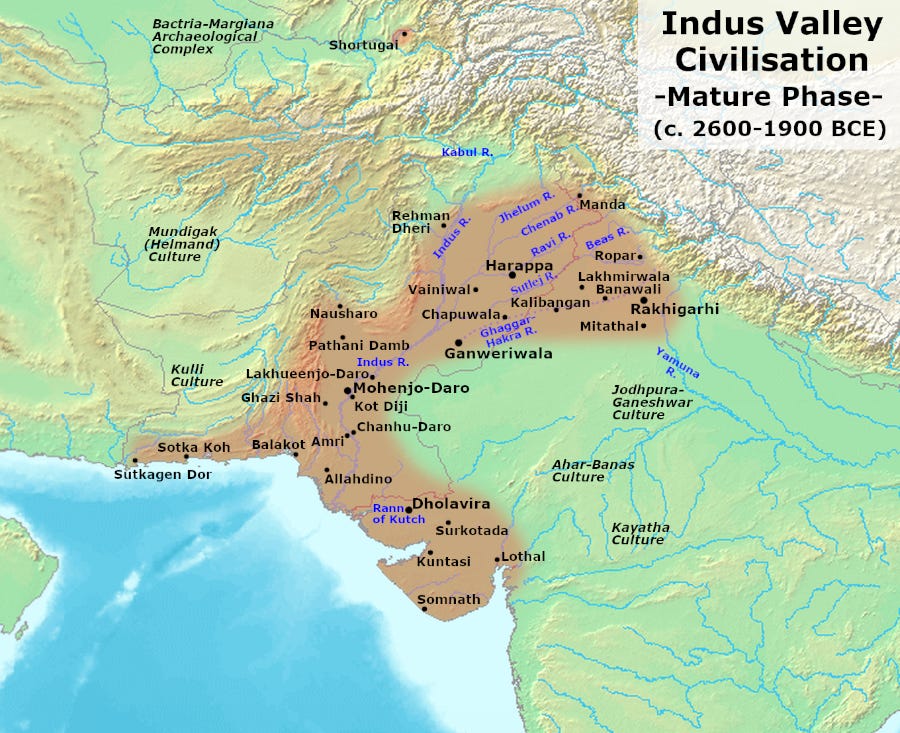
Born from the life giving waters of the Sarasvati and Indus rivers - the latter still one of the most important in the world - vast orderly settlements of mud-brick architecture are found throughout the modern nation state, as well as over the border into Northern India. Sprawling over a landmass considerably larger than any other in the Bronze Age world. The tell tale signs of their visitations are found much further away too in what is now Uzbekistan, Iraq and the Arabian Gulf - all across the known world of their day.
Masters of art, engineering and commerce - of a level far surpassing most human beings then alive on the planet - their fate and much of their way of life remains a total mystery. Though literate, their undeciphered pictorial script remains one of the great enigmas of the ancient world. Known as the Harappan culture today due to the name of the site first discovered and still one of its largest cities, it is popularly known under a different name - The Indus Valley Civilisation.
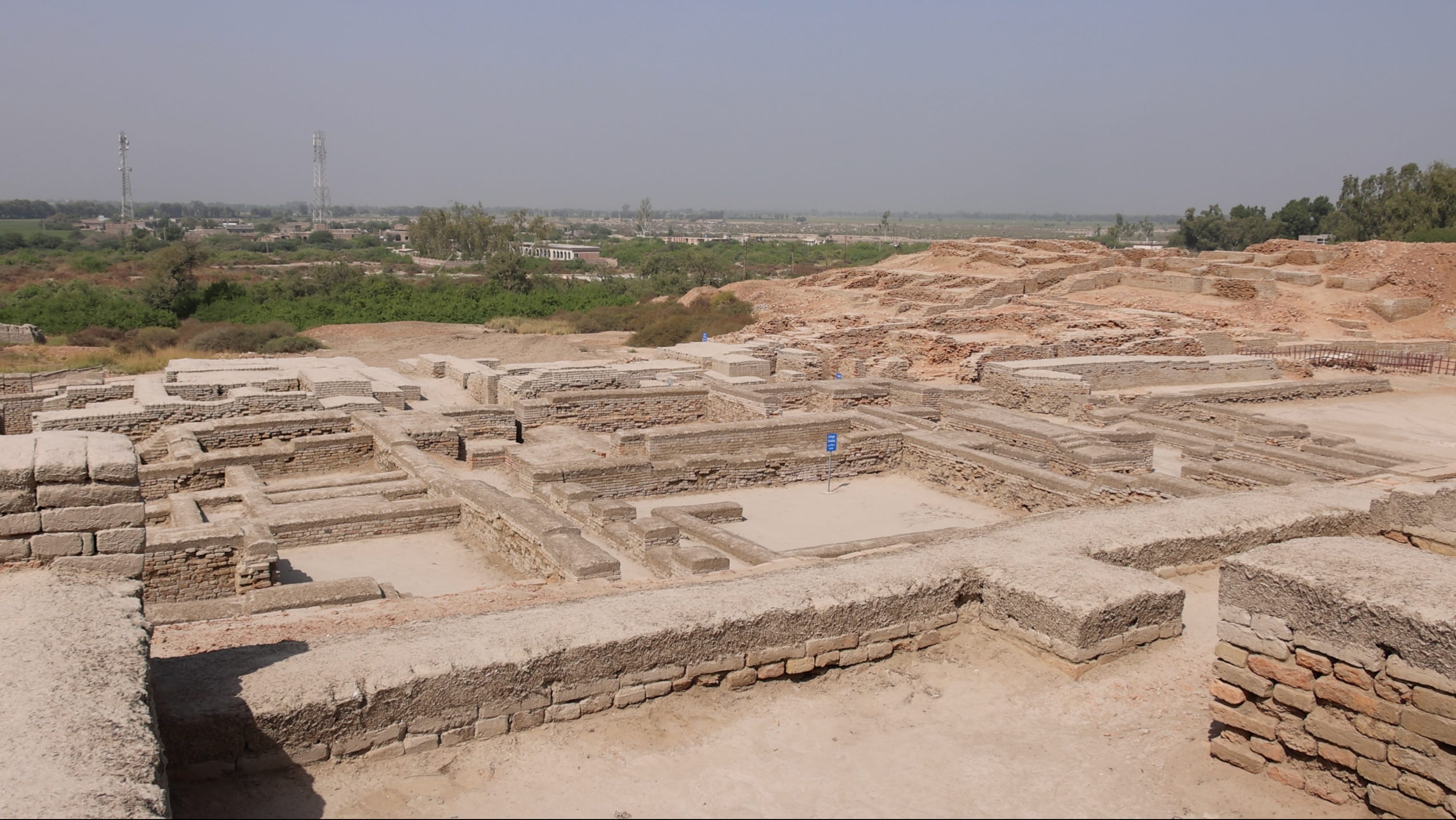
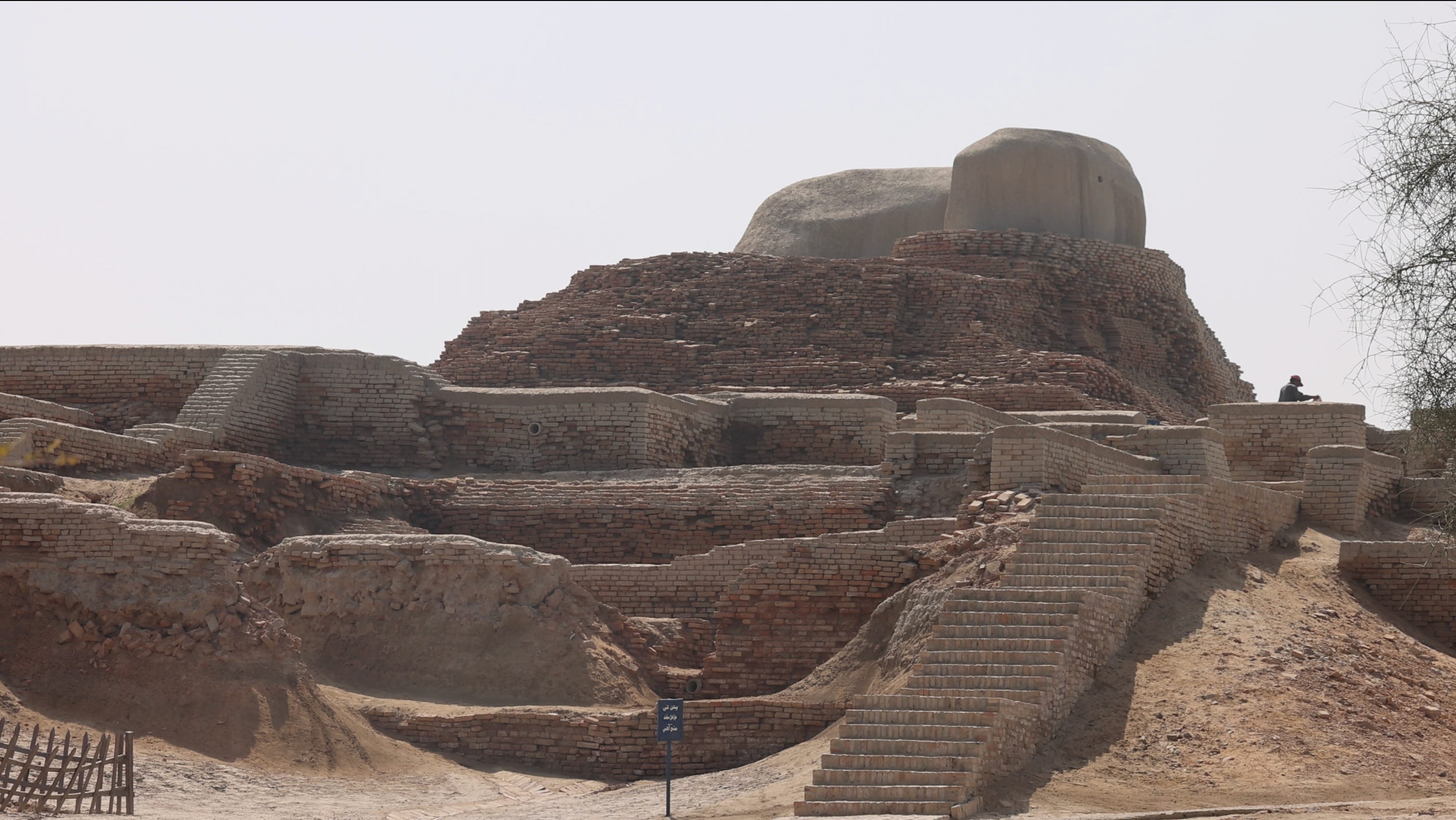
With streets whispering of globe spanning expeditions, unseen gods, and hidden wisdom seeming so far ahead of its time, the most famous city of all is not Harappa, but a vast mound of mud-brick refuse situated further down river. Constructed on top of a vast platform mound, which may have originated as a flood defence, it is an immensely impressive visage today. After you’ve seen it, you don’t forget a place like Mohenjo Daro.
Roughly translated as The Mound Of The Dead Men, digs undertaken here since the 1920s have revealed more secrets than at most Harappan sites. Giving archaeologists some of the most famous finds of all. And yet, today it rises from the dust like a riddle - streets once alive with activity now silent. I had plenty of time to ponder the mysteries of Mohenjo Daro when I arrived in October 2023. Patience very much being a virtue in modern day Pakistan.
We’d arrived on site an hour earlier after a lengthy voyage cross country to find we’d been deprioritised due to a surprise visit by the US ambassador. His security detail understandably in a permanent state of high alert given the history of political assassinations in the still young nation. The night before, a number of cockroaches casually wandered around my room when I’d returned from dinner, the distinct musk of cigarette smoke filtering around the specifically non-smoking room. Yet to be stricken down by the perfunctory stomach illness seeming to beset the British in this part of the world, the rest of our group of like-minded archaeological enthusiasts seeming to be struck down one by one, often in spectacular fashion on the open road - I just hoped to survive the visit to that most spectacular of Bronze Age cities. And Mohenjo Daro does not disappoint.
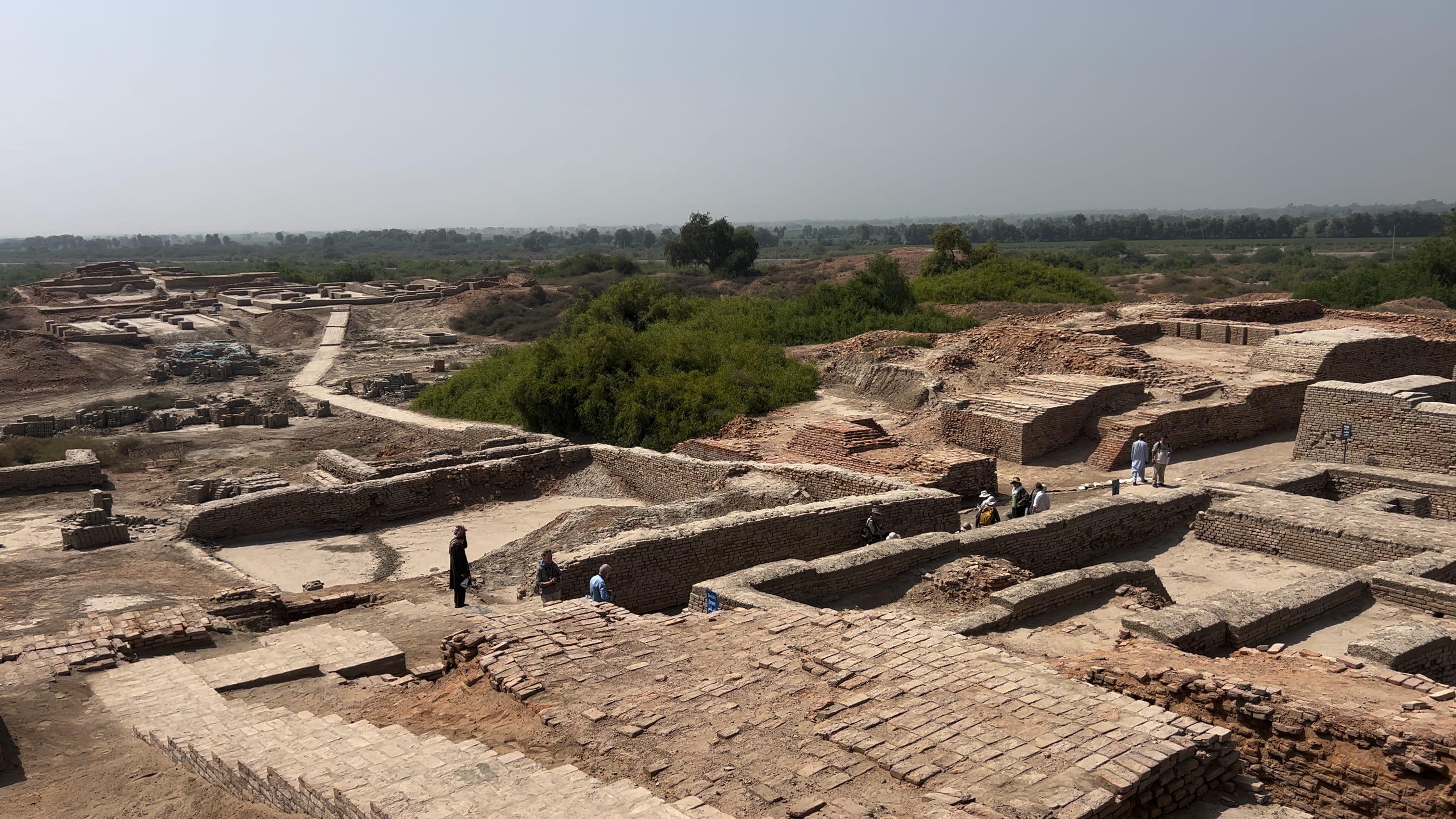
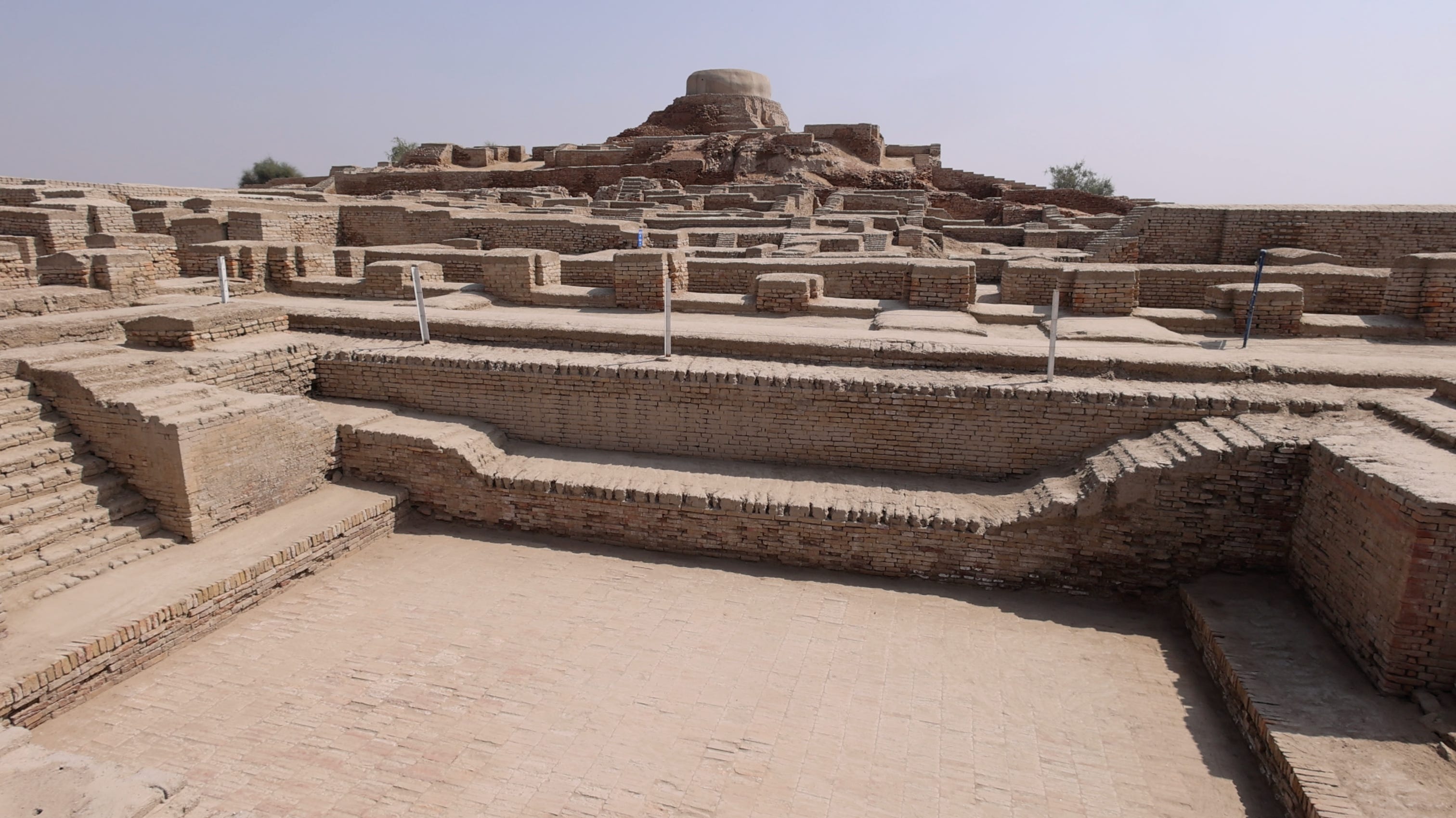
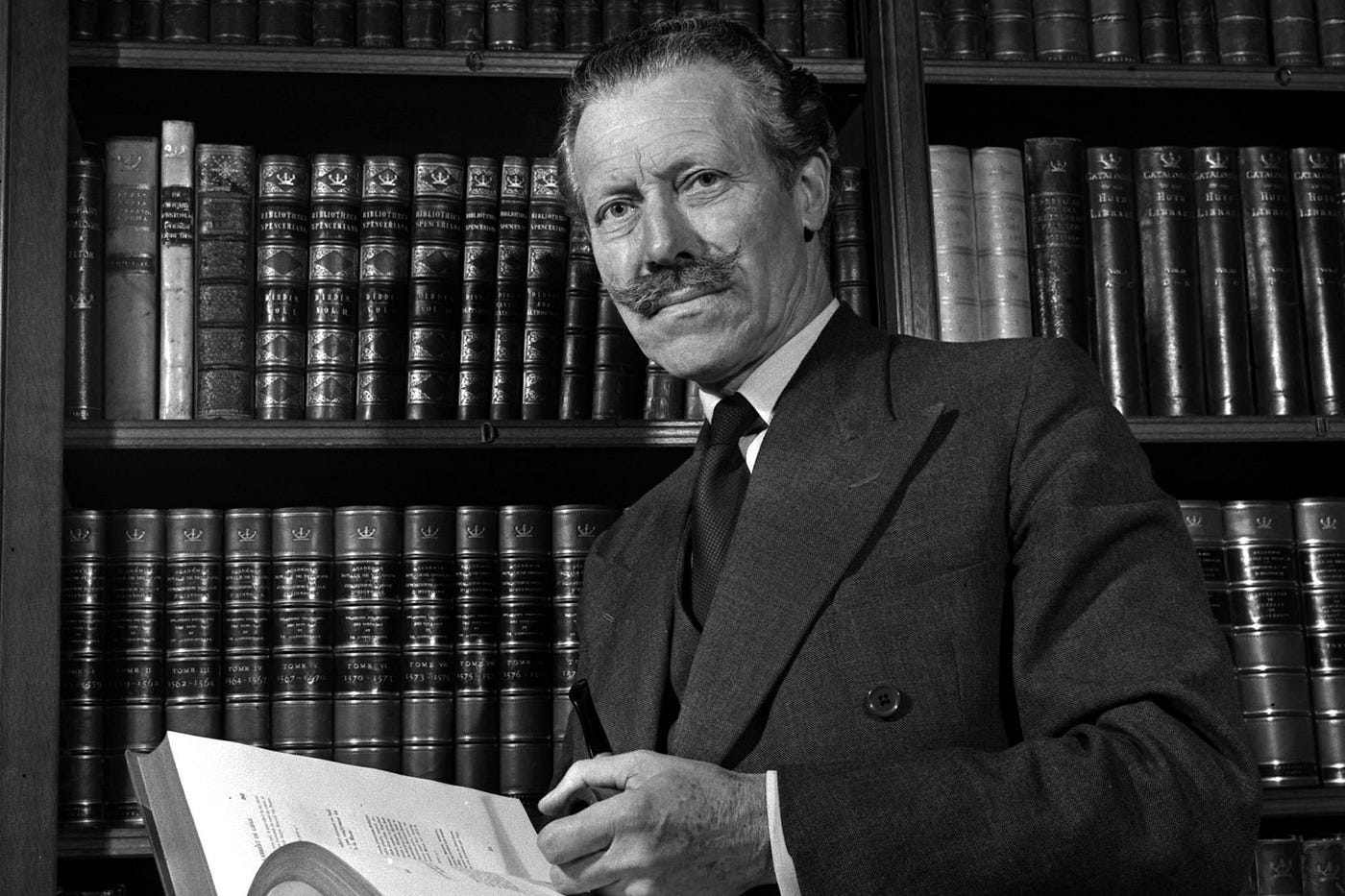
Since its discovery in the 1920s, and subsequent excavation by the legendary Sir Mortimer Wheeler, not yet then a knight of the realm but soon to be made one largely due to his contributions to world archaeology here, I’d read that the place had been gradually eroding away ever since. Though this undoubtedly is still the case - the sheer amount of digging over the past century leading to much of the exposed city being destroyed by the elements - there is still an immense amount to see. Labyrinthine passageways winding around the great central stupa, itself a relic from the later Gandhara and Kushan era when Buddhist rule here was the norm. Whether those late classical builders knew they were adding the final works to an already ancient city - the largest yet discovered in this part of the world - or whether they knew anything whatsoever of that once mighty civilisation, history does not relate. But when rediscovered in the 1920s, its existence had faded so completely that it wasn’t just lost to history, but even myth.
Despite attempts to link certain seal stones like the Pashaputi Seal to the later Hindu god Shiva, and others supposedly in yoga like poses, attempts in recent years to link the Indus Valley Civilisation to the earliest phases of Indian history have sometimes taken on a political edge, and have never been fully accepted by archaeology at large. As far as most researchers are concerned, this was something else entirely. Even today vast amounts lies un-excavated still, under subsidiary adjacent mounds to the main tell of which the stupa tops. The place was so abundant in fact, the same as Harappa nearly seven hundred kilometres away, that in the late Nineteenth Century large amounts of its bricks were used as readymade fill for railway tracks.
Even after its sudden fame in the 1920s however, the Indus Valley was generally seen as somehow inferior to the supposedly superior culture of Mesopotamia, the wellspring of Biblical times and subsequently much of the culture of the Western World. Out here in the borderlands of the sub-continent where the map had previously been blank, such a society could only be incorporated as a subservient power into the existing Near Eastern world.
Today with the benefit of a hundred years of scholarship we know that Harappan society in fact dwarfed Sumeria, and differed greatly from it. Still little evidence of warfare having ever been found, as well as a great uniformity of construction style and little evidence of social stratification even and burial evidence. No lavish graves like the Royal Burial Pits of Ur so famously excavated by Leonard Woolley at the start of the Twentieth Century.
The stark difference between Sumeria and the Indus can be encapsulated in a quote from Mortimer Wheeler himself. Actually remarking rather on the differences between Rome and Greece, Mortimer lamented the rigid uniformity of Rome compared to the wild experimentation and creativity of the Greeks. One being a unified empire with the same style everywhere, the latter a series of independent city states. Yet Rome triumphed. No one would argue Golden Age Athens to be more powerful than the empire. The standardised bricks, units of measurement, and architecture seen at all Indus Valley sites though covering thousands of kilometres in scale in this case being akin to the formulaic Romans.
Even beyond the still fertile rivers of the Indus, which allows Pakistan to have a vast population today in a relatively small area, another river once flourished, arguably just as great. Dead now - its course changed in antiquity - vast ruins still pin prick the desert around the dried out beds of the Ghaggar-Hakra river. Receiving way less monsoon rain now than the rest of the Indian sub-continent.
Heading up river towards Mohenjo Daro on a domestic flight from Karachi the day before, mighty metropolis of the coast and one of the world’s mega-cities, we’d made landfall in the provincial centre of Sukkur, gateway to Mohenjo Daro. In the airport on the way there a journalist and aid worker named Dev struck up a conversation about all things Pakistan, philosophy and much more, completely shattering my idea of the country as a monolith. Born and raised in the southern most region bordering with India, Dev is a Hindu, and not particularly religious. Grounded for two or three hours, a businesswoman befriended us too, arranging for Pakistani cookbooks in English to be given to all of us in huge elaborate boxes. She worked for Coca Cola and was on her way home after winning an employee of the month competition in Dubai. Upon finally boarding I was a little alarmed as the sound of a prayer blasted out over the tinny airplane speakers. Thankfully, Pakistan Air runs on more than faith alone.
The next morning as we headed over a bridge I got my first glimpse of the Indus. Like the Nile, the Amazon and the Yellow, undoubtedly one of the world’s great rivers and cradles of civilisation. It is a wildly impressive sight to behold. Soon enough as we reach the industrial outskirts of Sukkur on our rickety tour bus I see that we have already reached our first Indus Valley site. One of the largest of all in fact, Lakhan-jo-daro, once having spread all across town. Though largely coated in the urban sprawl today its excavators hypothesise it to have been by far one of the largest Harappan cities of all. Now, little more than rubble remains.
A few hours later we finally arrived at the outskirts of the Mound Of The Dead Men. Once the American Ambassador finally made his retreat, we moved in. Heading up to the citadel to get our first view of the entire site, sprawling as far as the eye can see all around. The Great Bath and the Stupa right there before us. Of course, the ‘Citadel’ is not alone. Extensive sections of the so-called lower city having been dug too. More than three hundred housing units, the most excavated at any city of the Third Millenium BC, giving archaeologists a wealth of data to work with. Its famed mysteries and differences from more well understand places like Ur not stemming from a lack of data, but its undeciphered writing system.
Nevertheless excavations have clearly demonstrated the city to be made up of a complicated series of habitation layers built on top of one another down the long ages of its occupation, from around 2700 to 1700 BC. The well shafts being the only constant down the long generations, consistently being extended further and further upwards as buildings ebbed and flowed.
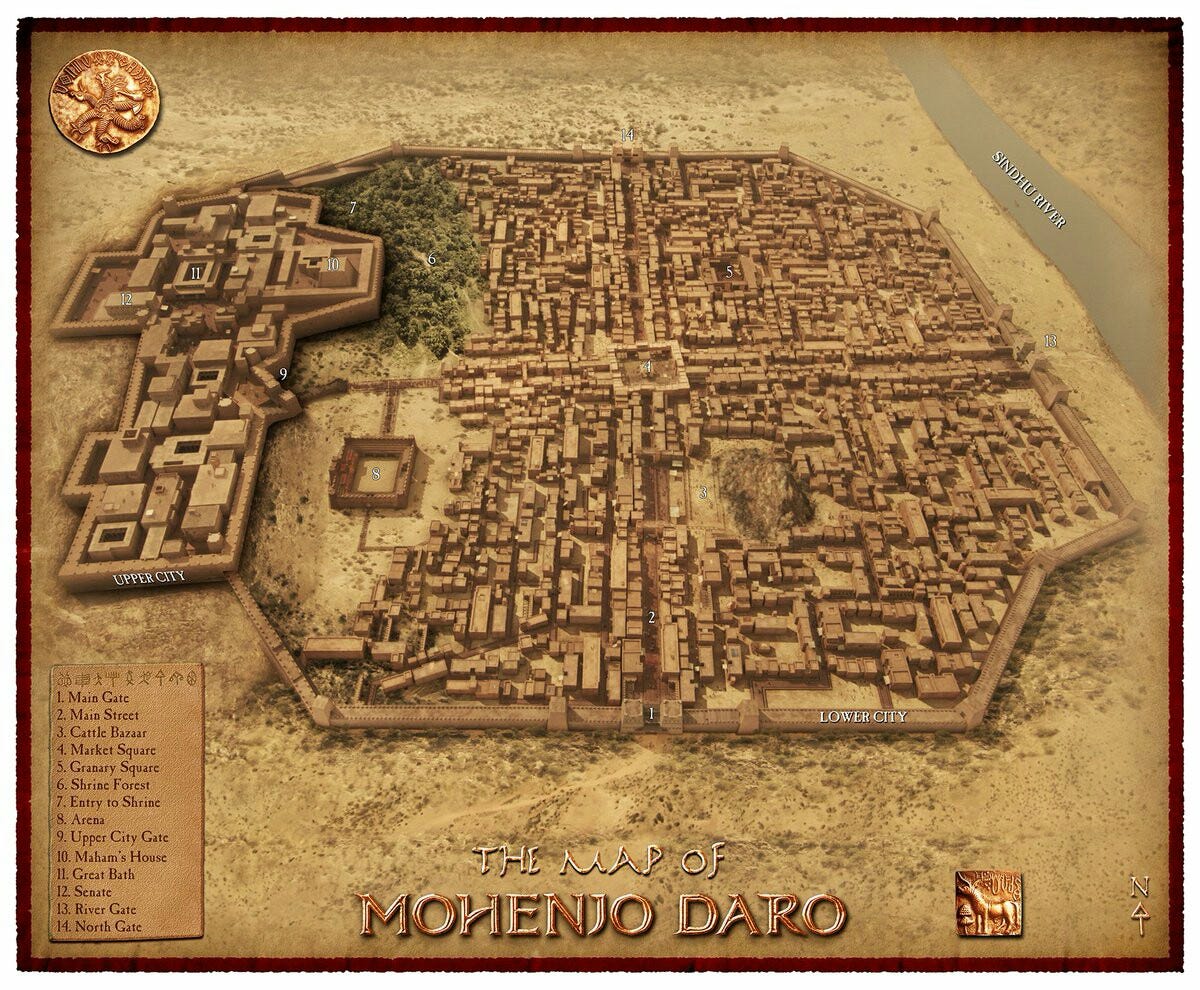
Standing on top of the citadel I begin to get a sense of the sheer scale of the city as another suburb of the city rises up in the distance. Many other such tells are still un-excavated. Even further away fortifications enclosed the entire site of some 300 hectares. Having visited many sites from the Third Millennium BC throughout the Aegean Sea, this absolutely dwarfs them all, estimated to have been home to some 40,000. Europe and Anatolia at that time being mere barbarians on the edge of the world.
But what sort of structure ruled the city? Whether it was kings, emperors even, priest rulers, or a caste of trader lords, no one can say definitively. The so called citadel once suggested to be a military stronghold during the days of Sir Mortimer Wheeler. But the evidence is lacking. No formalised burial traditions are found here at all, and burials overall are extremely diverse throughout the Indus world. At Dhovalira for example, just over the border in India, evidence of tomb-like chambers with beads and pots inside but no bodies have been investigated, suggesting cremation. Overall however, how the people of the Indus viewed death and religion remains ever elusive.
Archaeologist Gregory Possehl and many others since the very beginning have suggested an Indus obsession with water, most commonly seen with the so called Great Bath, a vast rectangular water tank of fine brickwork at the heart of the city. but also with its many wells, perhaps revealing a religious ideology based on ritual use. Other researchers remain skeptical. It may just be that Harappans were concerned with sanitation and cleanliness due to a prevalence of tropical disease. Some Indian scholars have even sought to link the Great Bath to later Hindu tradition. Though evidence for this is by no means definitive. Even the date of the stupa itself is not fully agreed upon. Though usually dated to the Kushan age due to the large amount of coins King Vasudeva I (191-232 AD), an Italian researcher Giovani Veradi, recently suggested it may have originally been a kind of ziggurat from Indus times, structures seen all across the civilised world at that time, from Mesopotamia to Turkmenistan.
After a couple of hours on site in the full heat of the day, we begin filing back out of the ruins to the welcome shade of the on-site museum. Like the similarly excellent Archaeology Museums in Karachi, Lahore, Taxila and Harappa itself, many of the exhibits are in English. A leftover from the days of the British Empire which I can’t complain about. An exceptional collection is to be seen, one of the best in the country. Not only were Harappans outstanding engineers, but sophisticated craftspeople of extraordinary skill. Still generally utilising tools of stone, though also versed in metal working, Harappan artisans created ornamental beads of turquoise, lapis lazuli, carnelian, agate, faience and more, from raw materials originating all over the world. Many would remain within what is now Pakistan, but some, such as the carnelian beads found in the Royal Graves of Ur in what is now Iraq traveled widely. Other goods show up everywhere in between, particularly in what is now Iran and Oman. And from that Persian Gulf region marine molluscs were imported to Harappan Cities. There the shells would be crafted into ornate jewellery, figurines, small vessels and even gaming pieces. The earliest dice and some of the earliest board games of the world being found here. Metal working of course was important too, with imported copper and tin being processed to create mirrors, jewellery and statuettes. Though in a unique situation for this time, evidence of weaponry is largely lacking.
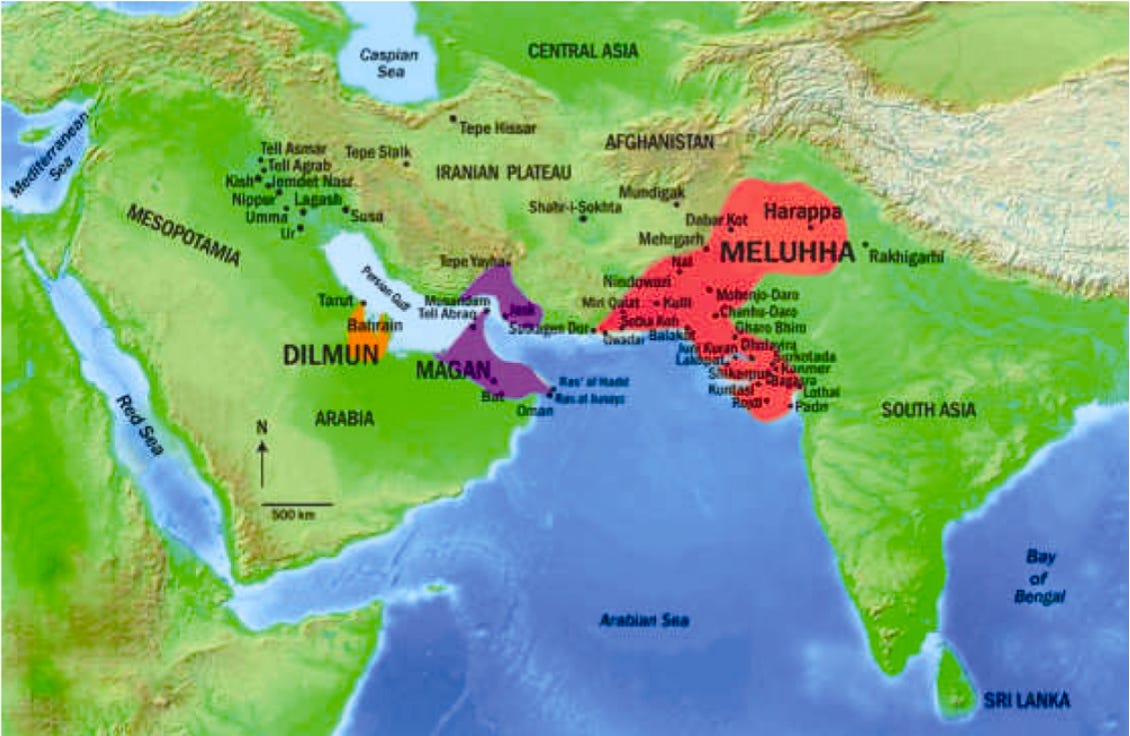
Like most ancient cultures however the most abundant objects of all are the ceramics. Indus Seals in particular, found in abundance at home, are also seen abroad at sites like Ur in Mesopotamia, which during its halcyon days at the end of the Third Millennium seems to have had a resident population of Indus Traders. Though we can’t read the Indus Script we can read the cuneiform of Ur which talk of flourishing trade at the time with the exotic lands of Meluhha beyond the sea, almost certainly the Indus Valley Civilisation. Resident traders would actually live in Mesopotamia as well as the lands of Dilmun and Magan in between, thought to be Bahrain and Oman respectively. Plying the open waters in reed boats with cotton sails, Indus merchants seem to have regularly taken the Monsoon winds across the Indian Ocean to Oman and from there up the Persian Gulf to Mesopotamia, in an especially lucrative system. Utilising the famous trade wind to cross 800 kilometres of open waters just as people still do today. The evidence overwhelmingly suggests Harappans were in control of the trade, the quarries and the markets. It was mostly their goods that ended up elsewhere without a lot found of the outside world at their sites, though it’s possible they were buying perishable goods. Gregory Possehl, an expert on this early world system, says that although not necessarily warlike as we would recognise it, the Indus people were ‘aggressive traders. There is no doubt about it’.
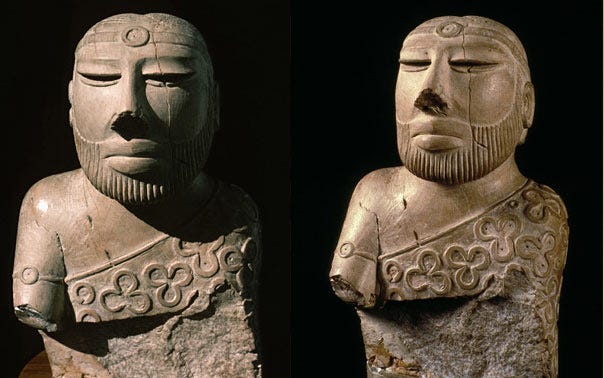
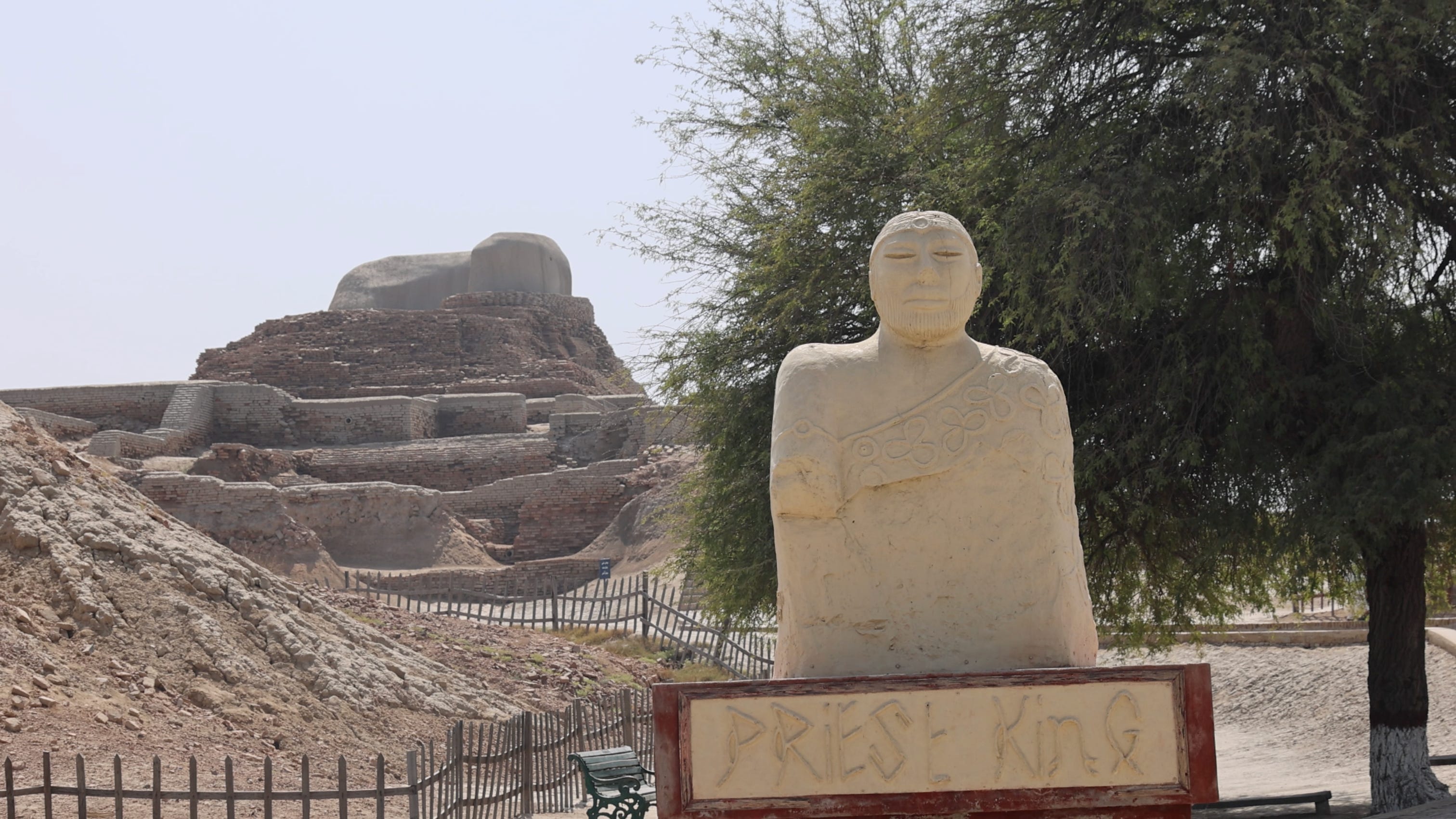
Though everyday household items of clay are the most common ceramics found at Mohenjo Daro, many terracotta figurines have been found too, depicting animals and humanoids. Traditions that existed long before at the Neolithic site of Mehrgarh from as early as 7000 BC. At Mohenjo Daro they may have served as guardians of household shrines - a small insight into the otherwise lost religion of the Indus. The most famous figurine of all, named the ‘The Priest King’ by its excavators a hundred years ago, has a good claim to being the mascot of the entire Indus Valley civilisation. It lives today in the excellent National Museum of Pakistan in Karachi. But here at Mohenho Daro the picture is greatly expanded by the exhibition of a whole collection of similar sculptures. Most having lost much of their definition over the millennia, though showing the Priest King to be part of a vigorous sculpture making tradition.
The other most famous artefact from Mohenjo Daro is the so called ‘Dancing Girl’. Named as such due to her perceived similarity to court dancers of much later periods in colonial India, though the reality of her appearance remains entirely speculative. Certainly she is adorned by many items which have been located archaeologically such as bangles, semi precious stones and necklaces. Other bodily adornments like nose studs earrings and conical head ornaments are seen too, all of which are still seen in modern India.
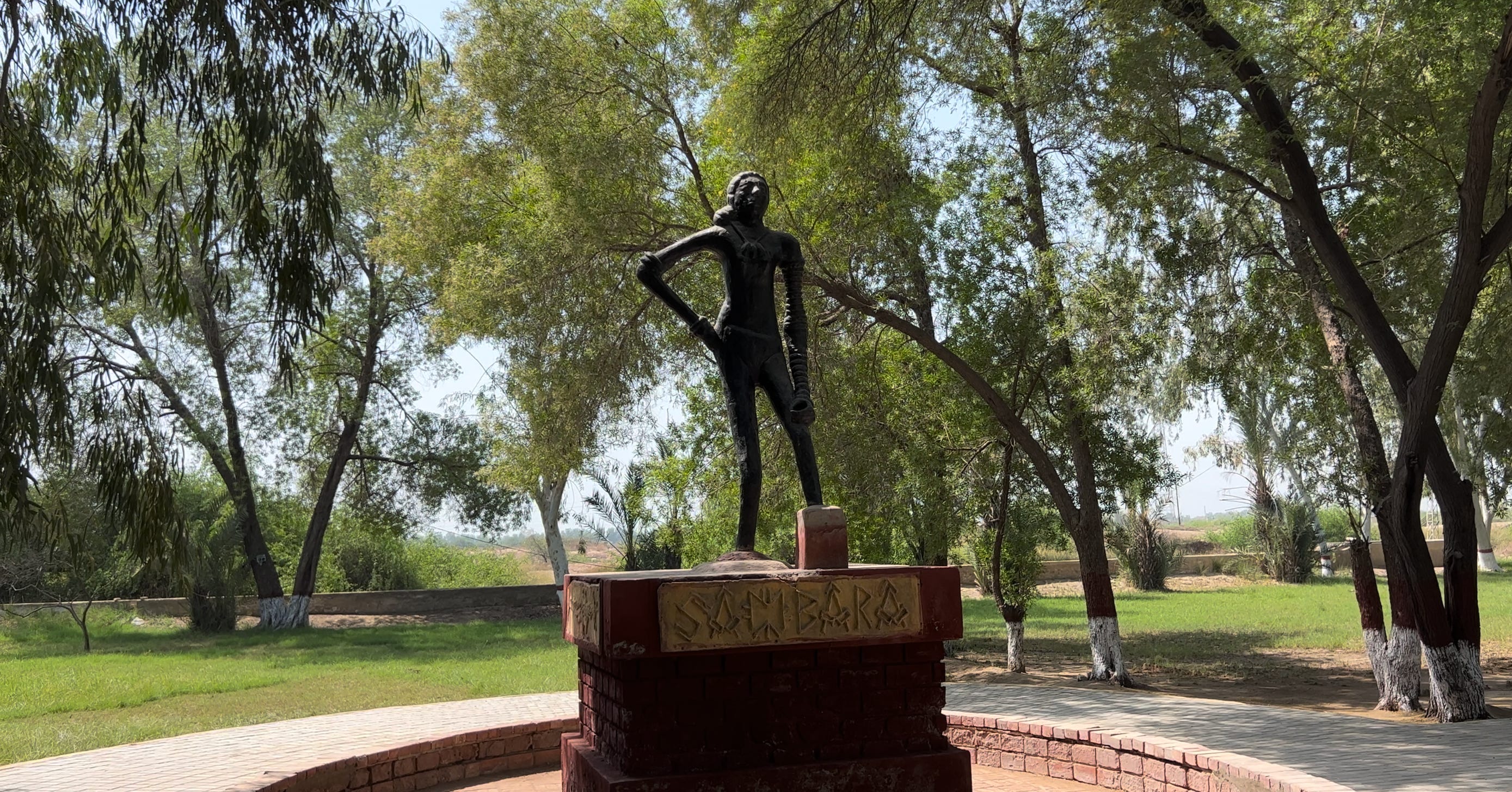
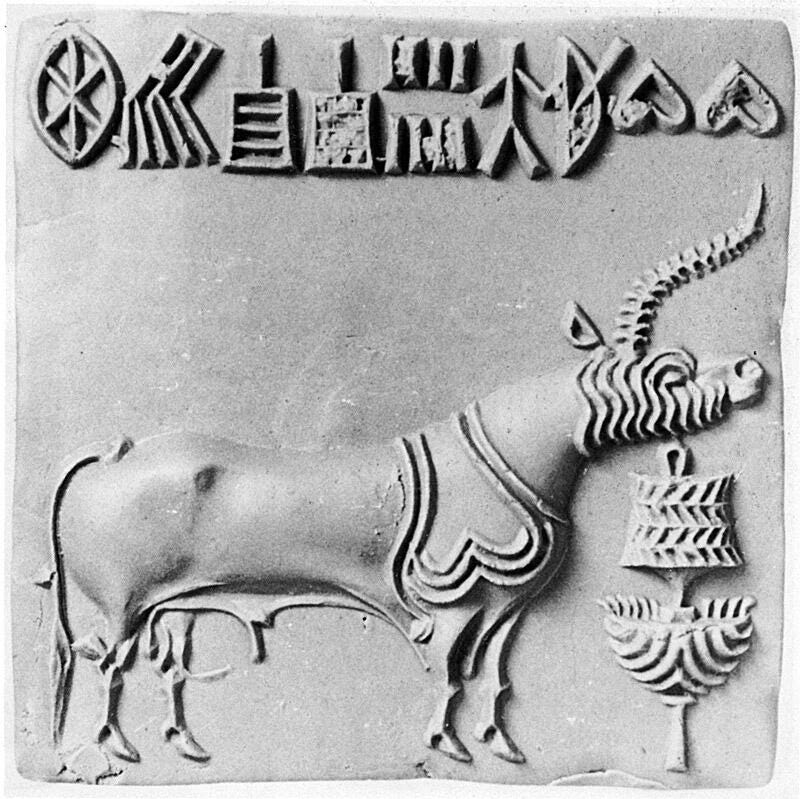
Back at the entrance after a hearty lunch I’d spotted what appeared to be a squirrel darting around. Recognising it from one of the many stamp seals I’d seen over the years. The other most famous one, fantastically named ‘The Unicorn’, I was yet to see, besides a large statue of it and a number of local stone masons selling replicas. Much has been made of this so called unicorn over the years, like the ‘Dancing Girl’ and the ‘Priest King’ it having become synonymous with Harappan civilisation. Indian archaeologists in particular have long sought to link it to later Hindu tradition, unicorns being a common creature in Indian folk stories such as Vishnu’s Titio of Ekasringa. Though just as likely to owe their origins to the rhinos which once thrived here. In reality ‘The Unicorn’ may simply be a bovine animal like a cow seen from the side.
The end of the Indus Valley Civilisation is one of the most thoroughly debated of any in the world. Much of the evidence suggesting one of the most significant cultural breaks in all prehistory. From the end of the Third Millennium BC on, a long decline was ushered in by climatic deterioration. Finally ending in the middle Second Millennium BC, by which time the land and culture which inhabited it was a shadow of its former self. No longer urban, literate or outward looking. Though the Indus itself survived the drought, as a result of a weakening of the monsoon weather system, the once lush Ghaggar-Hakra river was entirely dried up, leaving just wasteland where once lush forests and grasslands stretched. And here is where the controversy stems. At some point during the decline a new people arrived in North India. By the end of the Second Millennium BC this new culture had replaced the language of the Indus with an Indo-European one. It would be a thousand years before writing would emerge again, based on the entirely different language of the horse riding newcomers. Though very little is for certain here and so many mysteries remain, the non Indo-European family of Dravidian languages, surviving only in the southernmost regions of India, may be akin to the original tongue of Mohenjo Daro.
Heading back to the bus we meet up with our police escort - A bunch of guys with ak-47s hanging off the tuktuk in front of us - and on we go to our next destination. Like clockwork, with Mohenjo Daro completed, as if everything had been held together just for the event, my constitution begins to fall apart. Gazing out at the incredible sites and sounds on the highway around me, I settle in for a challenging six hour drive along bumpy dirt roads towards Harappa and Taxila beyond. A journey across thousands of years of South Asian prehistory.
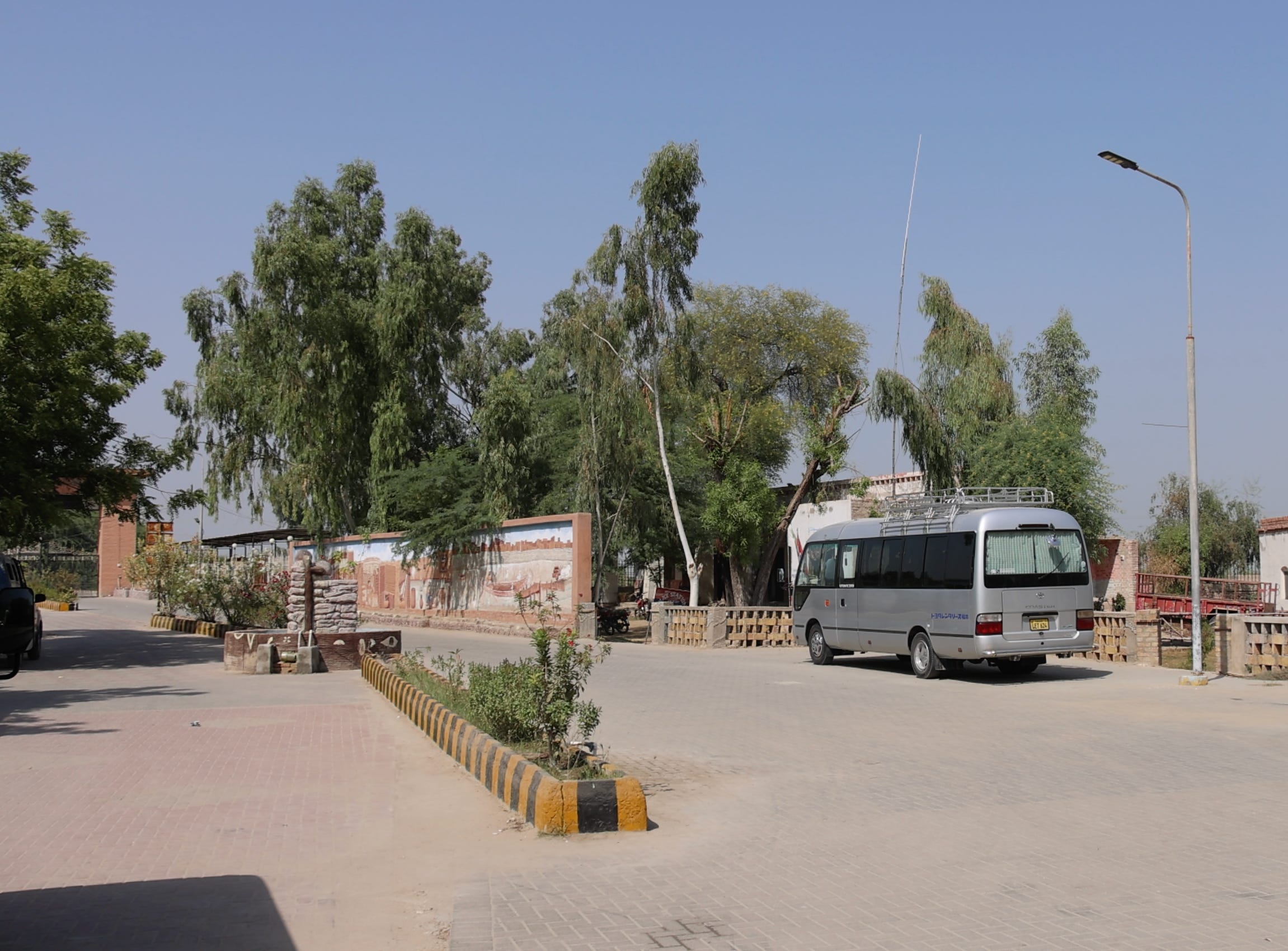
Wildly frustrating at times - the saga of attaining a visa and the chaos of Islamabad airport being particular highlights - Pakistan remains one of the greatest countries I’ve had the pleasure of visiting. The reality is that I was the impatient one. The Pakistanis around me approaching life with stoic acceptance. Always a welcoming grin and a happy face wherever I found myself.
In a nation where the Mausoleum of the beloved founder Muhammad Ali Jinnah (1876-1948) faces a real struggle to keep the lights on, and almost everyone lives in a state of poverty, Mohenjo Daro is of course at risk. With so much of the site now exposed to the air without protective covering, it is slowly being eroded away - more being lost every time it rains. If nothing is done, it is only a matter of time now before it all melts away into dust. As a direct result of its excavation; the gods they worshipped, baked bricks they made into homes, and script with which they recorded it all, disappearing forever.
A city once so alive, seeming so immortal, leaving just dust in its wake. Perhaps one day in the future archaeologists will dig through the remnants of our own world, marvelling at the records we left behind, and pondering as the writing suddenly goes blank, our histories lasting only as long as the computer chips on which they are stored. How long until our own towering cities of glass and steel will come to an end? Our story, like the Harappans before us will be nothing more than a layer of earth, ephemeral fragments and forgotten dreams.
Thanks for reading. If you want to know more about the fascinating world of the bronze age. Here’s a 6 and a half hour documentary I made on Greece during the Mycenaean era-
Yes, great stuff again, Mr Kelly.
I have watched your outstanding Mycenaean Documentary, and it filled in a lot of the missing pieces of my research on connecting the Indus civilisation with the UK culture, especially the Manichaeans Church, which existed in the Atlantic Facade until the sixteenth century, as primarily Buddhist oriented.
The connections between King Cyrus, and King Asoka, through the Hittite-Akkadian Royalty, from Troy, were actually the eventual founders of Britain, (Prittan), and New Troy, ‘Try Novantae’...ie London.
It was concentrated in the Eire and the Scottish aisles with centres also on the east of Scotland, Aberdeenshire, in the prime pastoral lands, since King Brutus’ sons, Alban, was given the choice lands of present Scotland, ‘Alban’ to rule.
As for that Bronze Age collapse?
That was when the comet Venus had a close brush with the Earth, circa 2,000 BC.
Thanks MTR
Excellent. Thank you